Article Body
Softeners for water range from $300 to $10,000. However most homeowners will spend between $1000 and $3,800 if installation is included. This wide range isn’t just random. It boils down to four factors, which include the type of system, its capacity, what company or brand you purchase through, as well as the amount of plumbing work that your home requires.
If you’ve begun shopping and have discovered the problem, one site claims $500, another claims $5,000, and the dealer who visited your home said $8,000. There’s no reason to believe that any of these are right. They’re Softeners just describing different parts of the same market. This guide breaks that market apart so you can see where your own number is likely to land — and where the hidden costs tend to hide.
What Determines the Price of a Water Softener?
Before comparing figures, it’s important to know the exact water softener price. Water softener aren’t a singular product, but rather one of the categories that ranges from a $300 clip-on descaler to an expensive $10,000 system that is professional grade, and the variations aren’t just about marketing.
Four factors drive most of the price variation:
- System type — salt-based ion exchange, salt-free conditioning, or magnetic/electronic descaling all work differently and cost differently.
- Grain capacity — how much hardness the unit can remove before it needs to regenerate, which scales with household size and local water hardness.
- Brand and sales channel — box store, direct-to-consumer online, or a local dealer selling in your home.
- Installation complexity — whether your home already has a bypass loop, drain access, and electrical nearby, or needs new plumbing added.
Water hardness itself is measured in grains per gallon (GPG). Anything above roughly 7 GPG is generally considered hard enough to justify treatment, and above 15 GPG is considered very hard — which typically pushes buyers toward higher grain-capacity systems and, in turn, a higher price.
Cost by System Type
The biggest cost driver is which technology you choose. Here’s how the main categories compare.
System Type What It Does Typical Cost Range
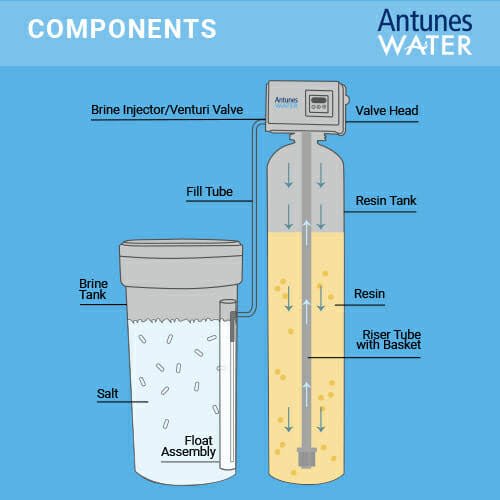
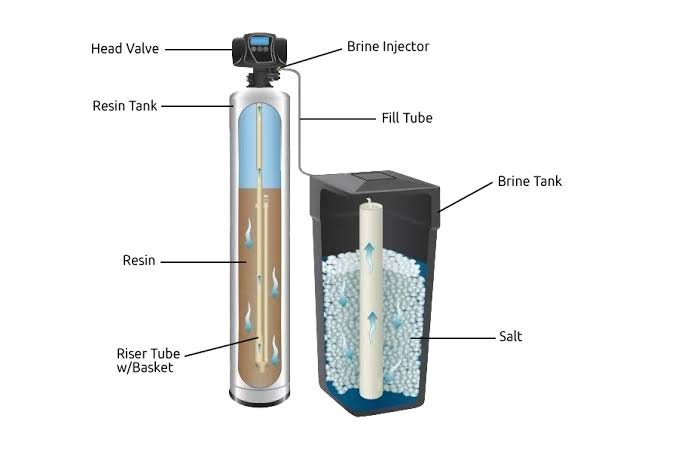
- Salt-based Ion exchange (single tank) Get rid of hardness minerals using salt brine and resin $500 – $1,700 per unit; $1,200 to $3,800 for installation.
- Salt-based dual-tank Similar procedure, except that one tank is used to supply water softener, while the other re-creates $1,000 – $5,000 per unit; $2,500 to $6,000 when installed
- Salt-free conditioner Alters mineral structure so it doesn’t stick to surfaces, without removing it $1,000 – $4,000
- Magnetic/electronic descaler Clip-on device claiming to reduce scale buildup $100 – $500
- Whole-home / light commercial High-capacity systems for large properties or severe hardness $5,000 – $25,000+
Ion exchange based on salt is the preferred choice for many households because it’s the only method that actually gets rid of hardness minerals, rather than changing their behavior. Salt-free conditioners are popular with people who prefer less maintenance and don’t want to be burdened by salt bags; however, they’re not the best option for water softener that is extremely hard, or if hair and skin issues are the most frequent complaint.
Dual-tank systems can solve a particular problem: when you use a single-tank softener, you’ll get a small amount of hard water while it regenerates itself, which is usually over the course of a few days. If this is a problem for larger families, the dual tank upgrade is well worth the price.
Sizing: How Household Size Changes the Number
Grain capacity is where a lot of buyers either overspend or undersize. The general pattern looks like this:
- 1–2 people: That’s not necessarily a bad trade: dealer pricing usually includes full-service plumbing, one bathroom: around 24,000 grains, typically $400–$700 for the unit
- 3–4 people, two bathrooms: 32,000–40,000 grains, typically $600–$1,200
- 5+ people or three-plus bathrooms: 48,000–64,000 grains, typically $900–$2,000
- Large households or very hard well water: 64,000+ grains, often $1,500–$3,500 and up
The only reliable way to know which tier you actually need is a water softener test — either a home test kit or a professional test, which many installers offer for free before quoting a system. Guessing at capacity is one of the most common ways people either overpay for a system they don’t need or end up replacing an undersized one within a few years.
Installation Costs: The Line Item Most Quotes Don’t Explain
This is where a lot of the confusion between quotes actually comes from. Two homes buying the same softener can end up with installed costs that differ by thousands of dollars, and it almost always comes down to plumbing, not the equipment.
A basic install — where your home already has an accessible water line, a bypass loop, and a nearby drain — typically runs $150 to $500 in labor. A more involved install, where any of that is missing, can run anywhere from $500 up to $11,000 in extreme cases.
What actually pushes installation cost up?
- No existing bypass loop (commonly adds $200–$900)
- No drain line near the install location, since water softeners need to drain during regeneration
- Electrical access needed for a digital control valve
- Well water setups that need pre-filtration for iron or sediment before the water softener
- Tight or finished spaces like crawlspaces or finished basements, which add labor time
- Remote locations that carry a travel or service-call fee
If you’re comparing quotes, ask for an itemized breakdown of unit cost, labor, and any plumbing additions separately. A $2,000 quote and a $6,000 quote for what looks like a similar system usually aren’t actually comparable until you see what’s built into each one.
For anyone comfortable with basic plumbing, DIY installation is a realistic way to skip that labor cost entirely. Many direct-to-consumer systems now ship with the resin pre-loaded and the bypass valve pre-installed specifically so a homeowner can complete the swap in an hour or two with standard tools.
Why the Same Type of Softener Can Cost 3x More: Buying Channel Matters?
This is the part most cost guides skip over, and it’s often the single biggest factor in what you end up paying.
Box store systems (GE, Whirlpool, Rheem) sit at the low end, typically $400–$800 for the unit. They use standard components and are generally DIY-friendly.
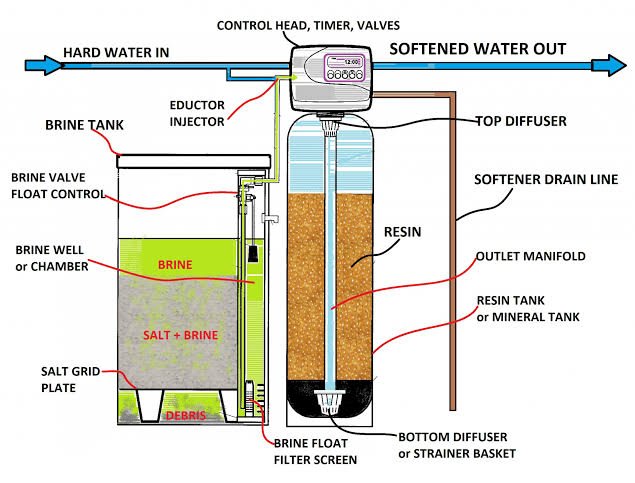
Direct-to-consumer brands sold online often use the same control valve manufacturers — Fleck and Clack are the two most common in the residential market — that professional dealers install. Without the in-home sales visit or dealer markup, these typically run $600–$1,700.
Local dealers (Culligan, Kinetico, EcoWater, Rainsoft, and regional installers) commonly price complete systems from $1,500 up to $10,000, with professional-grade systems often landing around $5,000.
The important thing to understand is that the gap between direct-to-consumer and dealer pricing isn’t always about hardware quality — it’s frequently sales commission, financing costs, and the in-home consultation itself. This isn’t necessarily a bad deal, as dealer prices typically include the full-service installation, continuous maintenance plans, as well as more local warranty service. However, it’s important to understand the exact cost prior to assuming that a higher cost implies higher quality equipment.
One credible marker to look for regardless of brand is NSF/ANSI 44 certification, which means an independent organization has verified the system actually performs the hardness-removal claims it’s being sold on.
Ongoing and Hidden Costs
The unit price is only part of the real cost of owning a softener. Budget for these recurring expenses too:
Expense Typical Annual Cost
- Softener salt (40 lb bags, $5–$10 each) $60 – $200
- Potassium chloride alternative $150 – $400
- Resin bed replacement (every 10–15 years) $150 – $500, one-time
- Filter changes on salt-free systems ~$40
- Repairs as needed $150 – $900, occasionally up to $2,000
- Slight water bill increase from regeneration $10 – $30
All in all, salt-based systems cost around $100 to $300 per year to keep. This is a small amount; however, it’s often absent from the sticker price discussion completely, and that’s one reason why the “real” cost of ownership frequently catches the eye of first-time buyers.
Buy, Rent, or Finance?
Buying outright is the cheapest option over time for anyone planning to stay in their home for more than a couple of years. Financing through a dealer — often available at 0% to low interest over several years — makes dealer-grade equipment accessible without a large upfront payment. Renting, which is typically between $25 and $50 per month, does not require any initial expense and typically comes with maintenance; however, it typically costs more than buying when you have it spread over three or five years. Renting is the most sensible option for short-term residents, renters or anyone wanting to test soft water before making the decision to buy.
A Simple Way to Decide
If you’re uncertain which is best water softener for your needs, this is an ideal place to start:
- Affordable, moderately hard Comfortable with basic plumbing .Direct-to-consumer or box-store single-tank system that you can install by yourself
- Larger household that doesn’t want a hard-water window during regeneration: a dual-tank salt-based water softener system
- Mild hardness, want low maintenance water softener, don’t want to deal with salt: a salt-free conditioner.
- Very hard water from a well or a vast home: a whole-home system that is likely to have pre-filtration
- You’re renting or aren’t sure what the length of your stay will be: a monthly rental.
- Want the sales visit, financing, and full-service installation handled for you: a local dealer system.
None of these is objectively “best” — they’re trade-offs between upfront cost, convenience, and long-term maintenance effort.
FAQ
Does a water softener truly worth the cost?
For the majority of homes that have really tough water (above 7 GPG) It is.The price of a water softener will typically be less than the overall cost of scaling in pipes, decreased efficiency of water heaters, as well as additional detergent and soap use. If you live in areas with typically water softener, your expense is less important.
What’s the time span for which the water softener can be expected to operate?
A well-maintained water softener salt-based system can last 10 to 15 years prior to the salt bed having to be changed, and the tanks and valves are stronger when they’re kept in good condition.
Do I need assistance by an engineer for setting the water softener?
Not always. If your house already has a water softener line, bypass loop, as well as a drain nearby, the majority of homeowners can install softeners on their own within a couple of hours. Homes that require an upgrade in plumbing, electrical work or well-water pre-filtration require the assistance of a professional.
What will it cost to run water softeners?
Ongoing costs usually range from $100 to $300 per calendar year with salt-based solutions. These costs are for repairs, salt replacements, as well as a slight increase in water usage due to regeneration cycles. Salt-free systems are more affordable to run, however they’re more expensive initially.
What size of water softener do I need to buy?
The majority of 3-4-person households with bathrooms are made up of 32,000 to grains of water softener.But the only reliable method of confirming this is to perform the test of water hardness because the hardness levels in your area are prone to fluctuate.
Is it cheaper to lease or buy an water softening device?
It is usually cheaper to buy when you buy over a long time.A $35-a-month rental adds up to over $2,000 across five years — comparable to or more than many owned systems, without ever building equity in the equipment.
Why are water softeners so expensive?
Pricing spans such a wide range because it bundles several separate costs — the unit itself, installation labor, any plumbing prep the home needs, and in dealer sales, a sales and service markup. Two different systems using similar hardware may have very different costs based on the way these costs are covered.
What is the cost of a house-based water softener?
Systems for residential use throughout the residence typically run between $1,200 and $6,000 when they’re put in. Systems that are larger or combine softening and iron-removal filtering can cost between $5,000 and $25,000, and even more.
Conclusion
There’s no single honest answer to water softener — but there is a reliable range. Most households land between $1,000 and $3,800 all-in for a standard salt-based water softener system, with the final number shaped far more by installation complexity and buying channel than by the softener itself.
The most useful thing you can do before buying is get a real water hardness number, request an itemized quote rather than a flat price, and decide upfront whether you’re paying for equipment alone or for the full-service experience a dealer provides. Once those three things are clear, the “it depends” pricing you’ll see everywhere else stops being confusing and starts being a range you can actually plan around.
These information about Projector Mount are gathered from different surveys, medical tests and tech giants like Techradar and more. Our top priority is to provide you valuable information.
For More Details About Different Water Filter Click Here