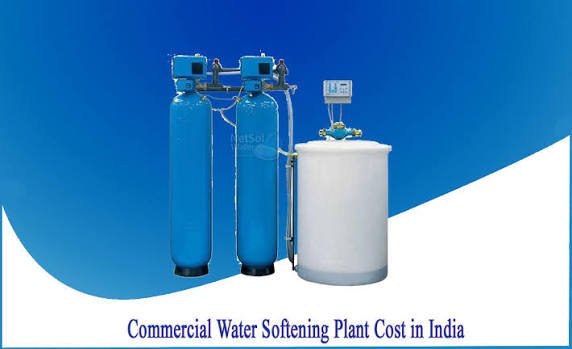
What Is a Commercial Water Softener System?
A commercial water softener system uses ion-exchange resin to swap hardness minerals (calcium and magnesium) for sodium or potassium, preventing limescale in boilers, kitchens, laundries and pipework. It is sized by peak flow rate and daily hardness load, not by building size.
Put simply, it is a larger, tougher cousin of the household softener. It handles higher flow, heavier daily demand and, in many designs, keeps soft water running while one tank regenerates.
You will also see it called an industrial water softener, a cation exchange softener, a duplex water softener or, in parts of South Asia and the Middle East, a commercial water softener system plant or softener skid.
Why Hard Water Costs Businesses Money?
Hard water leaves scale on every hot surface it touches. Scale insulates heating elements and boiler tubes, so equipment works harder and fails sooner.
The damage shows up in several places:
- Heating elements and boiler tubes coated with calcium carbonate
- Spray arms, nozzles and valves clogged in dishwashers and car wash equipment
- Cloudy glassware and spotted cutlery
- Stiff, dingy linen in hotel and laundry operations
- Higher detergent and descaling chemical use
- Equipment warranties that require treated water
One buyer’s guide estimates hard water pushes commercial water softener system dishwashers and laundry equipment to consume 10–25% more detergent and water. Treat that as a vendor estimate, but the direction is reliable: soap and detergent work less effectively in hard water.
How Hard Is “Hard”?
The USGS classification is the most widely cited scale:
| Class | Grains per gallon (gpg) | mg/L as CaCO₃ |
| Soft | 0–1.0 | 0–17.1 |
| Slightly hard | 1.0–3.5 | 17.1–60 |
| Moderately hard | 3.5–7.0 | 60–120 |
| Hard | 7.0–10.5 | 120–180 |
| Very hard | Over 10.5 | Over 180 |
Above roughly 7 gpg, most commercial water softener system operators see enough scale to justify softening. Above 10.5 gpg it is rarely optional.
Hardness Units Around the World
Suppliers quote hardness in different units depending on the market. Here is how they convert:
| Unit | Where it is common | Equivalent |
| gpg (grains per gallon) | USA, Canada | 1 gpg = 17.1 mg/L |
| mg/L or ppm as CaCO₃ | Global, lab reports | Base reference |
| °dH (German degree) | Germany, Central Europe | 1 °dH ≈ 17.85 mg/L ≈ 1.04 gpg |
| °fH (French degree) | France, parts of Europe | 1 °fH = 10 mg/L ≈ 0.58 gpg |
| mmol/L | UK, EU lab reports | 1 mmol/L = 100 mg/L |
Convert everything to one unit before comparing quotes or sizing a system.
How a Commercial Water Softener System Works?
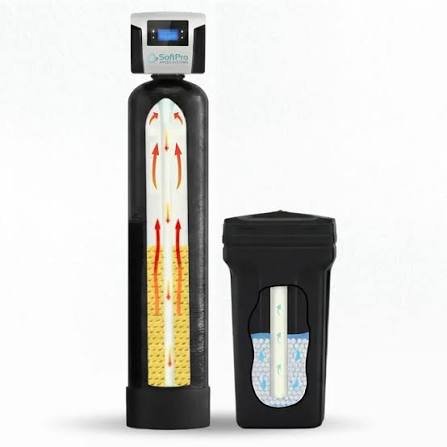
Hard water passes through a pressure vessel filled with strong-acid cation exchange resin, usually 8% crosslinked polystyrene beads. The beads hold sodium ions. As water flows past, calcium and magnesium swap places with sodium and stick to the resin.
The water leaving the tank is soft. Eventually the resin runs out of sodium and needs to be recharged.
The Regeneration Cycle
Regeneration restores the resin with a concentrated salt brine from a separate brine tank:
- Backwash: upward flow loosens the resin bed and flushes sediment
- Brine draw and slow rinse: brine displaces hardness minerals from the resin
- Fast rinse: clean water flushes out remaining brine
- Brine refill: the brine tank refills for next time
The waste (brine plus hardness minerals) goes to drain. That is why drain access, an air gap and local discharge rules matter.
Timer vs. Meter-Initiated Control
A timer-based control regenerates on a fixed schedule, whether the resin needs it or not. A meter-initiated (demand-initiated) control counts the gallons used and regenerates only when capacity is nearly spent.
Meter-initiated control is the standard for commercial water softener system work because it saves salt and water. Some manufacturers go further. One high-efficiency design claims 40–50% less salt and regeneration water by bringing tanks online and offline as flow changes, though that is a manufacturer claim worth verifying.
Types of Commercial Water Softener Systems
Simplex (Single Tank)
One resin tank. During regeneration, supply is either interrupted or bypassed with hard water. It suits businesses with a quiet overnight window, such as offices and small shops.
Duplex (Twin Tank)
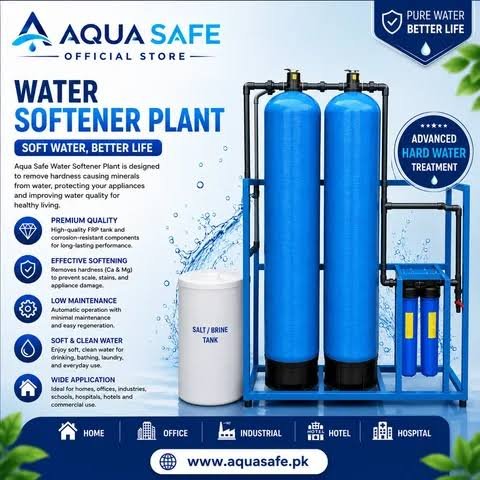
Two tanks, so one is always available. This is the default for 24/7 operations like hotels, hospitals and laundries.
| Duplex mode | How it works | Best for |
| Alternating | One tank in service, the other on standby or regenerating | Continuous supply at moderate flow |
| Parallel | Both tanks serve together; one drops out to regenerate | Higher peak flow |
Triplex and Multi-Tank
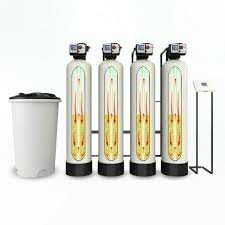
Three or more tanks handle large flows and add redundancy. Many designs can be expanded later by adding tanks, which helps if your demand is likely to grow.
Skid-Mounted and Packaged Systems
Pre-plumbed and pre-wired, these install quickly. Floor-standing vessel systems may suit mechanical rooms with narrow doors or low ceilings.
Boiler Feedwater Commercial Water Softener system
Boilers need commercial water softener system close to zero hardness. Check the boiler manufacturer’s feedwater limits and, for larger plants, standards from bodies such as ASME.
Sodium vs. Potassium Chloride Regeneration
Sodium chloride is cheapest and most common. Potassium chloride adds no sodium but costs more. Operators sometimes choose it where sodium discharge or intake is a concern.
Commercial water softener system vs. Residential Softeners
| Feature | Residential | Commercial |
| Typical demand | Intermittent | Continuous or high-frequency |
| Flow rate | A few gpm up to about 12 | Tens to hundreds of gpm |
| Resin volume | About 1–2 cubic feet | Several to dozens of cubic feet |
| Valves and controls | Basic | Heavy-duty, programmable, alarms |
| Redundancy | Rare | Common (duplex or more) |
| Service | Occasional | Scheduled, often contracted |
A household unit on a commercial water softener system load wears out quickly. Valves, distributors and resin all take the strain.
How to Size a Commercial Water Softener system?
Sizing is where most projects succeed or fail. Two numbers drive everything: peak flow and daily hardness load.
Step-by-Step Sizing
- Test the water. Measure hardness, plus iron, manganese, chlorine or chloramine, pH and TDS.
- Find peak flow in gpm. Add up what can run at the same time. Each vessel has a recommended service flow rate, so this sets the minimum number and size of tanks.
- Estimate daily water use. Use meter readings if you have them.
- Calculate grains per day. Daily gallons × hardness in gpg.
- Choose a regeneration interval. Many commercial water softener system designs aim for 1.5–2 days of reserve capacity between regenerations.
- Convert to resin volume. Divide the capacity you need by the capacity per cubic foot (higher salt dose gives more capacity per cubic foot but lower salt efficiency).
- Check flow. Confirm the vessels’ service flow rating covers peak gpm.
- Add a margin. A modest allowance for growth and seasonal swings avoids early undersizing.
Worked Example: A 60-Room Hotel
Assume 15,000 gallons per day and 15 gpg water.
| Step | Calculation | Result |
| Daily load | 15,000 × 15 | 225,000 grains/day |
| Two-day capacity | 225,000 × 2 | 450,000 grains |
| Resin volume | 450,000 ÷ ~25,000 grains/cu ft | About 18 cubic feet |
Because this hotel runs around the clock, a duplex arrangement splits that resin between two tanks, each sized for the full load or arranged in parallel for peak flow. Confirm exact vessel choices with the manufacturer’s capacity and flow tables.
Which Industries Need One?
- Hotels and resorts: boilers, hot water, laundry, guest bathrooms
- Restaurants and commissary kitchens: dishwashers, combi ovens, steamers, ice machines, coffee equipment
- Laundries and laundromats: high flow, detergent savings
- Car washes: spray equipment, often paired with reverse osmosis for a spot-free final rinse
- Healthcare: autoclaves, boilers, humidification
- Breweries and food processors: boilers and process water
- Manufacturing: boiler feedwater, cooling, process lines
- Apartment blocks and offices: central water heaters, air conditioning loops
Scenario:
A 40-seat restaurant in a hard-water area sees white film on glassware and descales its combi oven monthly. A small duplex softener on the kitchen supply, plus a carbon filter, typically reduces descaling work and chemical use. Results depend on hardness and how the commercial water softener system equipment is run.
Simplex or Duplex?
A Quick Decision Framework
Work through these questions in order:
- Is hardness above about 7 gpg, or is scale already damaging equipment? If not, monitor and retest.
- Can you tolerate hard water during regeneration? If yes, simplex. If no, duplex.
- How high is peak flow? High peaks point to parallel duplex or triplex.
- Is there iron, chlorine or chloramine? Add pre-treatment.
- Are brine discharges restricted? Consider potassium chloride, high-efficiency designs or alternatives.
- Do you need very low TDS as well? Add reverse osmosis downstream.
Salt-Based Softeners vs. Alternatives
Ion exchange is the only mainstream method that truly removes hardness at commercial water softener system scale, apart from membranes. Alternatives suit specific cases.
| Option | What it does | Strength | Limitation |
| Template-assisted crystallization (TAC) | Turns hardness into tiny crystals that resist sticking | No salt or brine drain | Hardness stays in the water, so soap performance doesn’t improve like true softening |
| Reverse osmosis | Membrane removes dissolved solids | Very low TDS | Cost, reject water, usually for specific loops |
| Nanofiltration | Partial hardness removal | Lower pressure than RO | Cost, fouling |
| Polyphosphate scale inhibitors | Delay scale formation | Low capital cost | Limited at high temperatures |
| Electronic or magnetic descalers | Claimed to alter scale behavior | Low cost | Evidence is mixed; ask for independent testing |
Treat salt-free claims with care. A conditioner may reduce scale adhesion, but if your equipment warranty specifies soft water, check the exact wording before substituting.
What Does a Commercial Water Softener System Cost?
Reliable commercial water softener system price benchmarks are scarce, because cost depends on flow, resin volume, controls and site conditions. Use these as planning guidance, then get written quotes.
| Cost element | What drives it |
| Equipment | Resin volume, tank count, valve and control type |
| Installation | Plumbing, drain, electrical, bypass, pre-treatment |
| Salt | Water use, hardness, regeneration efficiency |
| Water | Regeneration uses water |
| Service | Contract level and response time |
| Resin replacement | Water quality, chlorine and iron exposure |
For perspective, home softeners commonly run from roughly $800 to $3,000 installed, with dual-tank and well-water setups higher. Commercial water softener system equipment sits well above that. Published retail listings for 2-inch commercial control-valve systems start in the high four figures, and large multi-tank skids climb from there.
Total Cost of Ownership
Compare lifetime cost, not the sticker price. Add equipment, installation, salt, water, service and eventual resin replacement, then subtract the savings: fewer repairs, less descaling, lower detergent use and longer equipment life.
Buy, Lease or Service-Exchange?
- Buy: lower long-run cost, but you carry maintenance
- Lease or rent: low upfront cost and predictable fees
- Service-exchange tanks: the provider swaps regenerated tanks off-site, which avoids on-site brine discharge
Installation, Standards and Compliance
Standards to Look For
- NSF/ANSI 44: performance of cation exchange softeners
- NSF/ANSI 61: drinking water system components and health effects
- WQA programs: industry certification, including certified water specialists
- Boiler manufacturer and ASME guidance: feedwater hardness limits
- Local plumbing codes: backflow prevention and air gaps
Installation Basics
Install the system after the main meter and any sediment filtration, and before water heaters or boilers. Provide:
- A bypass valve for servicing
- Pressure gauges on inlet and outlet
- A code-compliant air gap at the drain
- A solid base, with piping supported independently of the tank
- Power and floor-drain access
- A hard-water tap for irrigation or uses that don’t need soft water
Check temperature and pressure limits. Many systems operate only between about 34°F and 110°F (1°C–43°C).
Brine Discharge Rules
Some municipalities restrict salt-regenerated softeners because of chloride in wastewater. This has been a particular issue in parts of California, and similar rules exist elsewhere. Check local wastewater requirements before you buy.
Regional Considerations
Hardness, units and regulation vary by market:
- US and Canada: gpg, NSF certification, municipal brine rules
- UK and Europe: °fH, °dH or mmol/L, water-company requirements
- UAE and Gulf states: desalinated and blended supply; scale control for cooling and hospitality
- South Asia: borewell and municipal supply with high TDS; “softening plant” terminology
- Australia and New Zealand: supply varies widely by region
Your utility’s water quality report gives the hardness figure for your supply. A site test gives the real number at your tap.
Pre-Treatment: Protect the Resin
Commercial water softener system resin is sensitive to certain contaminants.
- Iron and manganese can foul resin. An iron filter upstream helps.
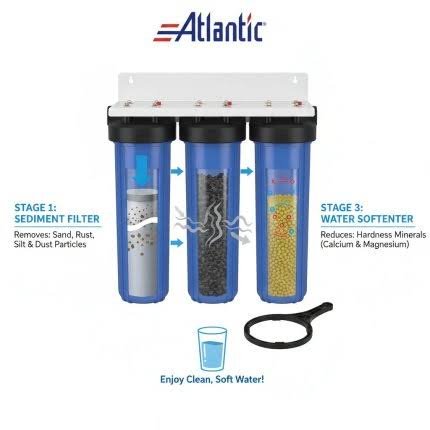
- Chlorine and chloramine degrade resin over time. Carbon filtration upstream protects it.
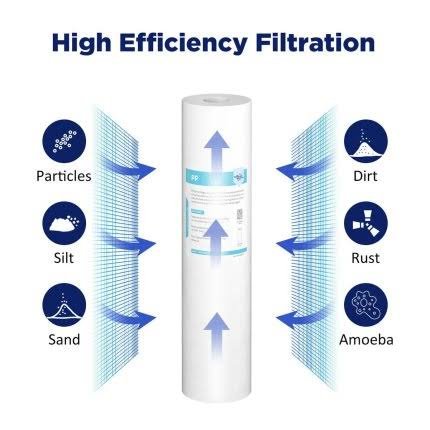
- Sediment clogs the bed and distributor. A sediment filter helps.
Resin life depends heavily on this. In good conditions, one competitor guide cites 10–15 years for resin and 10–20 years for tanks and valves, and shorter with high iron or chloramines.
Maintenance and Troubleshooting
Maintenance Checklist
- Check salt level weekly and keep it above the water line
- Test treated water hardness monthly
- Look for salt bridging or mushy salt in the brine tank
- Clean the brine tank and inspect the injector, valves and meter each year
- Sanitize the resin bed as the manufacturer advises
- Review capacity against actual demand annually
Common Problems
| Symptom | Likely cause | Fix |
| Hardness in treated water | Undersized unit, spent resin, failed meter | Retest, check sizing and valve |
| Salt not dissolving | Salt bridge | Break the bridge, clean the tank |
| Low flow or pressure | Fouled resin or clogged distributor | Check pre-treatment, service the bed |
| Excess salt use | Timer control or wrong settings | Switch to demand control, review dose |
| Hard water bursts | Channeling in the bed | Inspect distributor and service flow rates |
Common Mistakes to Avoid
- Sizing by room count or square footage instead of flow and hardness
- Skipping a water test before quoting
- Using a simplex unit on a 24/7 operation
- Ignoring iron and chlorine
- Forgetting drain and discharge rules
- Softening water that doesn’t need it, such as irrigation lines
- Buying on price alone without a service plan
How to Choose a Supplier?
Ask any provider these questions:
- Will you test our water on site before quoting?
- Can you show the sizing calculation, including flow and regeneration interval?
- Which standards do your products meet?
- What is your emergency response time?
- What does the service agreement cover?
- Can we speak to a similar facility you serve?
- Who handles permits and discharge compliance?
- What are the warranty terms on valves, tanks and resin?
Be cautious of quotes with no water test, no mention of peak flow or vague warranty language. For service providers, look for water treatment credentials, licensed plumbing or mechanical qualifications and clear service-area coverage.
Frequently Asked Questions
How much does a commercial water softener system cost?
It depends on flow, resin volume and site conditions. Small systems start in the low-to-mid thousands, while large multi-tank installations reach well into five figures. Add installation, salt and service, and get written quotes based on a water test.
What size commercial water softener system do I need?
Multiply daily water use by hardness in gpg to get grains per day. Multiply by your regeneration interval, divide by resin capacity per cubic foot, and confirm the vessels cover your peak gpm.
What is the difference between commercial water softener system and residential water softeners?
Commercial water softener system handle higher flow and heavier daily demand. They use larger resin volumes, stronger valves, programmable controls and often have redundant tanks.
How often does a commercial water softener system regenerate?
Well-sized commercial water softener systems commonly regenerate every day or two. Meter-initiated controls trigger regeneration based on actual water use rather than a fixed clock schedule.
How long does a commercial water softener system last?
Tanks and valves can last 10–20 years with maintenance commercial water softener system, and resin often 10–15 years in good conditions. Iron, chlorine and chloramine shorten resin life.
Do restaurants need a water softener?
In hard-water areas, usually yes. Soft water protects dishwashers, ice machines, steamers and coffee equipment, and many manufacturers specify water quality for warranty coverage.
Is a duplex commercial water softener system worth it?
For operations that run around the clock, yes. One tank regenerates while the other supplies soft water, so you avoid hard-water gaps.
Are salt-free systems as effective as salt-based softeners?
Not at removing hardness. Salt-free conditioners like TAC may reduce scale adhesion, but they leave calcium and magnesium in the water.
Can a commercial water softener system be restricted?
In some places, yes. Certain municipalities limit salt-regenerated softeners because of chloride discharge, so check local rules first.
Does a commercial water softener system make water safe to drink?
No. It addresses hardness only. Drinking-water safety may require additional filtration or disinfection.
Conclusion
A commercial water softener system is a sizing and service decision as much as an equipment purchase. Get the flow rate and daily load right, and it protects boilers, kitchens and laundries for years. Get them wrong, and you waste salt and still fight scale.
Your next steps:
- Test your water for hardness, iron, chlorine and TDS.
- Gather peak gpm and daily gallons from meters or equipment specs.
- Calculate grains per day and pick a regeneration interval.
- Decide between simplex and duplex based on downtime tolerance.
- Check local discharge rules and permit needs.
- Request two or three quotes with the sizing shown.
- Plan maintenance and resin protection from day one.
- Retest the treated water after installation.
These information about Projector Rental are gathered from different surveys, medical tests and tech giants like Techradar and more. Our top priority is to provide you valuable information.
For More Details About Different Water Filters Click Here