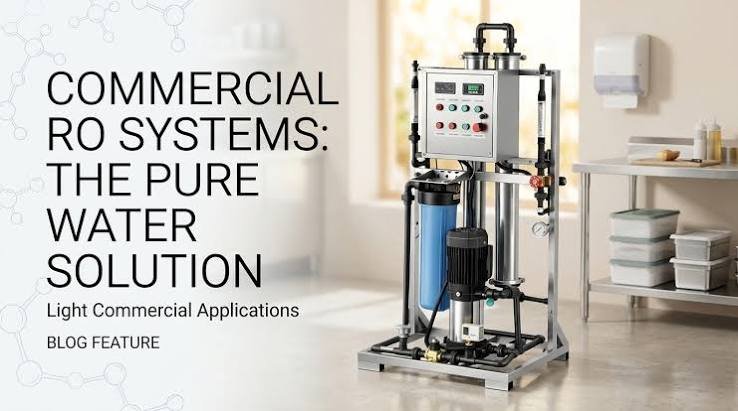
What Is a Commercial Reverse Osmosis System?
A commercial reverse osmosis system is a high-capacity water purification unit that uses pressure to push water through semi-permeable membranes. It removes most dissolved salts, minerals and contaminants, giving restaurants, hospitals, factories and other businesses consistent, high-quality water.
You may also see it called a commercial reverse osmosis system plant,commercial reverse osmosis system machine or skid-mounted RO unit. Larger installations are usually described as industrial reverse osmosis.
The principle is simple. Natural osmosis moves water toward the saltier side of a membrane. A pump applies pressure above the water’s osmotic pressure and reverses that flow. Clean water (permeate) passes through, and the rejected salts leave as a concentrate stream, often called brine or reject.
Why Businesses Install One?
Water quality shows up in your product and your equipment bills. Scale chokes boilers and espresso machines. Dissolved solids spot glassware and cloud ice. In food, beverage, medical and lab settings, the wrong water can fail an audit.
Common triggers for buying a system:
- Scale or spotting complaints that softening alone hasn’t solved
- A new facility or kitchen build-out
- Equipment warranties that specify a water quality limit
- An audit or compliance requirement
- Product inconsistency traced back to the water supply
How It Works, Step by Step?
- Intake. Municipal, well or surface water enters the system.
- Pretreatment. Sediment filters, carbon and softening or antiscalant dosing protect the membranes.
- Pressurization. A high-pressure pump lifts feed water above its osmotic pressure.
- Membrane separation. Water passes through thin-film composite (TFC) spiral-wound elements. Well-known membrane makers include Dow FILMTEC, Hydranautics and AXEON.
- Permeate collection. Purified water goes to a storage tank or point of use.
- Concentrate discharge. The reject stream carries away what the membrane held back.
- Optional post-treatment. UV, remineralization, pH adjustment or polishing add the final touches.
Two figures describe performance. Rejection is how much of a contaminant the membrane removes. Commercial reverse osmosis system units commonly quote 95 percent or more salt rejection, and some suppliers claim up to the high 90s for dissolved solids. Recovery is the share of feed water that becomes permeate. Many commercial reverse osmosis systems run somewhere between 50 and 75 percent, depending on feed chemistry and design.
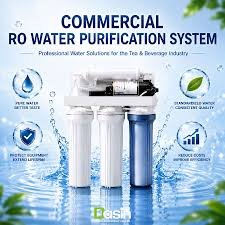
Who Needs a Commercial Reverse Osmosis System?
Typical users include:
| Sector | Why RO is used |
| Restaurants, cafés, hotels | Taste, clear ice, protection for coffee machines and steam ovens |
| Breweries and beverage producers | A controlled, repeatable mineral profile |
| Healthcare, dental, laboratories | Feed water for sterilizers and downstream purification |
| Car washes | Spot-free final rinse |
| Manufacturing and electronics | Rinse, cooling and boiler makeup water |
| Greenhouses and hydroponics | Precise nutrient control |
| Water refill stations | Consistent bottled and refill water |
Residential units generally can’t keep up with these demands. A commercial setting needs higher flow, multiple points of use and a storage tank, which is why dedicated commercial reverse osmosis system hardware exists.
Types of Commercial Reverse Osmosis Systems
By Feed Water
- Brackish water RO (BWRO): for wells and moderately salty sources, operating at pressures up to several hundred psi.
- Seawater commercial reverse osmosis system (SWRO): for ocean water, needing far higher pressure and corrosion-resistant materials.
- Municipal tap water commercial reverse osmosis system: the most common commercial reverse osmosis system case, treating chlorinated city supply.
By Configuration
| Type | Best for | Trade-off |
| Compact or wall-mounted | Cafés, small clinics | Limited output |
| Packaged skid | Mid-size facilities | Needs floor space and a drain |
| Containerized or portable | Remote or temporary sites | Higher unit cost |
| Two-pass RO | Higher purity targets | More pumps and cost |
| RO plus EDI or DI polishing | Labs, electronics, pharma | Added complexity |
| Custom engineered plant | Large or complex sites | Longer lead time |
Capacities vary a lot between product lines. One vendor’s wall-mount range covers roughly 1,800 to 5,400 gallons per day. Others advertise modules from about 100 up to 12,000 gallons per day, and engineered plants go well beyond that. In metric terms, small commercial reverse osmosis system units start at a few hundred litres per hour.
Key Components Worth Understanding
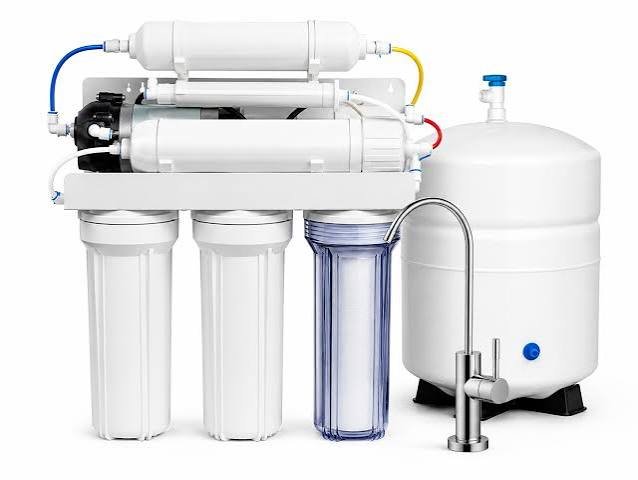
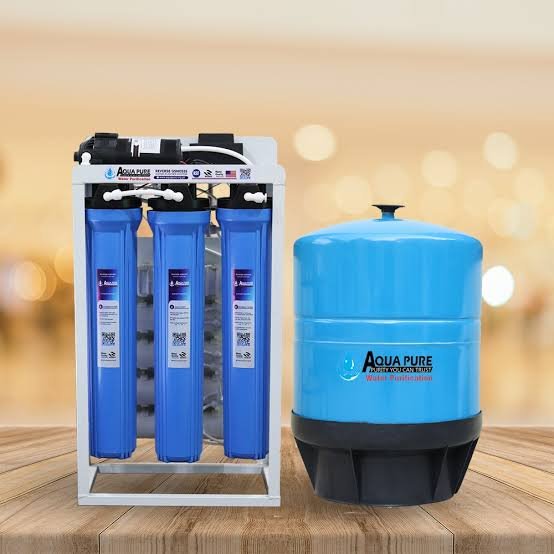
- Membranes and pressure vessels: the core of the system, often in 316L stainless steel or fiberglass housings.
- High-pressure pump: commercial systems use industrial-grade pumps rather than residential boosters.
- Prefilters and carbon: protect membranes from sediment and chlorine.
- Antiscalant dosing: slows mineral scale formation.
- Controls and sensors: flow meters, pressure gauges, conductivity monitors, low-pressure shutoff and alarms.
- Permeate tank and repressurization pump: let the commercial reverse osmosis system run steadily while serving demand peaks.
How to Size a Commercial Reverse Osmosis System?
Undersizing leaves you short during peaks. Oversizing wastes capital and can leave water sitting in storage. A sound sizing process looks like this:
- Add up demand. List every point of use, then estimate average daily volume and peak flow.
- Plan storage. A permeate tank lets a smaller unit cover short peaks.
- Test your feed water. Request a lab analysis covering TDS, hardness, iron, manganese, silica, chlorine or chloramine, pH, alkalinity, temperature and silt density index (SDI).
- Correct for temperature. Membrane output is rated at a standard temperature. Cold feed water cuts production, and a common rule of thumb is a few percent per degree Celsius, so winter capacity can fall noticeably.
- Set a quality target. Decide the permeate conductivity or TDS you need.
- Check drain limits. Your recovery setting determines how much reject goes down the drain.
- Leave room to grow. Many systems can add membranes later.
Example:
A restaurant needing roughly 1,500 gallons (about 5,700 litres) of RO water a day for ice, beverages and dishwashing doesn’t need a unit sized for the instantaneous peak. A storage tank lets a smaller system run across the full day.
Ask any vendor to run their projection software against your actual water report, not a generic assumption.
Pretreatment:
Where Most Systems Succeed or Fail?
Membrane problems usually start upstream. TFC polyamide membranes are sensitive to chlorine, and hard or dirty feed water fouls them quickly.
| If your water has… | Typical pretreatment |
| Chlorine or chloramine | Activated or catalytic carbon |
| High hardness | Softener or antiscalant |
| Iron or manganese | Oxidation and filtration |
| Sediment or turbidity | Multimedia or cartridge filtration |
| High SDI | Ultrafiltration or finer prefiltration |
| Silica | Specialized antiscalant and lower recovery |
| Biological growth | Disinfection, UV or biocide management |
Scaling tendency is often predicted with the Langelier Saturation Index (LSI). If your supplier can’t explain how they’ve addressed it for your water, ask.
Standards and Compliance
Which rules apply depends on your industry and country. Common references include:
- NSF/ANSI 58 for RO drinking water systems and NSF/ANSI 61 for materials in contact with drinking water
- U.S. EPA drinking water regulations and FDA 21 CFR requirements for food and beverage production
- WHO drinking-water guidelines as an international benchmark
- ASTM D1193 and USP purified water for laboratory and pharmaceutical grades
- AAMI water quality standards for dialysis and medical use
- Local plumbing codes and discharge rules for reject water
A dialysis clinic and a car wash use the same core technology but face very different validation, monitoring and documentation duties.
What Does a Commercial Reverse Osmosis System Cost?
Price depends mainly on capacity, then on pretreatment, materials, controls and installation. One U.S. supplier’s 2026 guide puts the overall range at about $2,000 to $80,000. It lists a 500 GPD unit at roughly $3,500 to $6,000, a 2,000 GPD unit at $8,000 to $15,000, and a 10,000 GPD unit at $25,000 to $50,000. Treat these as orientation figures and get written quotes.
Costs per gallon fall as systems get larger. Budget for more than the machine:
| Cost item | What drives it |
| Equipment | Capacity, membrane count, pump size, materials |
| Pretreatment | Softener, carbon vessels, filtration, dosing |
| Installation | Plumbing, electrical, drain, tank, labor |
| Compliance | Permits, discharge approvals, validation |
| Consumables | Prefilters, antiscalant, cleaning chemicals, membranes |
| Energy | Pump size and operating hours |
| Water and sewer | Reject volume at your utility’s rates |
| Service | Maintenance contract and emergency calls |
Prices differ by country and market, so use local-currency quotes for your own budget.
Lease, Buy or Pay Per Gallon
| Option | Fits when |
| Buy | Demand is stable and you can maintain the system |
| Lease or rent | Capital is tight or demand is uncertain |
| Water-as-a-service | You want a predictable cost per gallon with vendor-managed performance |
Compare total cost of ownership over five to ten years rather than the sticker price. Membranes, energy, reject water and service often outweigh the initial purchase.
Energy, Recovery and Reject Water
Higher recovery saves water but raises scaling risk and can increase pressure and energy demand. Lower recovery is gentler on the membranes but sends more water to drain.
At 50 percent recovery, roughly half of the feed water becomes reject. That is a real cost where sewer charges are high. Some sites reuse reject water for cooling towers, irrigation, floor washing or toilet flushing, subject to local rules. Check discharge regulations early, because they vary widely between regions.
Commercial RO vs. Other Treatment Options
| Option | Best for | Limitation |
| Water softener | Hardness and scale only | Doesn’t remove most dissolved salts |
| Activated carbon | Taste, odor, chlorine | Little effect on TDS |
| Nanofiltration | Partial softening and organics | Less complete salt rejection |
| Ultrafiltration | Particles and bacteria | Doesn’t remove dissolved salts |
| Deionization (DI) | Very high purity, small volumes | Resin regeneration and chemicals |
| EDI | Polishing after RO | Needs RO upstream |
| Distillation | Specific lab or pharma uses | High energy use |
Most facilities pair commercial reverse osmosis system with a softener or antiscalant program. The softener protects the membranes, and RO handles the dissolved solids.
When RO Isn’t the Right Answer?
RO is not always the smartest spend. Consider alternatives if:
- Your feed water is low in TDS and the complaint is only chlorine taste (carbon may be enough).
- Hardness is your only issue (a softener is cheaper to run).
- You have no practical drain or reject disposal route.
- Demand is so low that delivered or bottled water costs less over time.
Good vendors will tell you this. If every answer you get is “buy commercial reverse osmosis system,” compare a second quote.
Remineralization for Taste
Commercial reverse osmosis system water is low in minerals, which some drinkers and baristas find flat. Cafés and beverage operators often blend in filtered water or add a remineralization cartridge to dial in taste and protect equipment. Some commercial units are built with blending controls for exactly this reason.
Maintenance and Troubleshooting
- Daily or per shift: check pressure, flow and permeate conductivity, and look for leaks and alarms.
- Monthly: log normalized performance and inspect pretreatment and chemical levels.
- Quarterly: replace prefilters and sanitize if your standards require it.
- Annually: service pumps and instruments, re-test feed water, and clean or replace membranes when output drops or pressure differential climbs.
Common warning signs and likely causes:
- Falling permeate flow: fouling, scaling or cold feed water
- Rising permeate TDS: worn membrane or O-ring leak
- Rising pressure drop: fouling or scaling in the membrane array
- Frequent shutdowns: low feed pressure or pretreatment failure
Membrane life varies with feed quality and care. Equipment frames, pumps and controls typically last much longer than the membranes themselves.
Regional Considerations
Water and regulations change by location, so ask any installer how they handle your local conditions:
- Arid regions, including the US Southwest and the Gulf: very hard or brackish supplies make scale control and brine disposal central.
- Cold climates such as Canada and northern Europe: plan extra capacity for low winter feed temperatures.
- The UK and Europe: hard water is common, and material approvals and drinking water rules shape equipment choices.
- Drought-prone areas such as California and Australia: reject-water limits and reuse incentives matter.
- Coastal sites: seawater-grade equipment and corrosion planning come into play.
When you search for providers, look for a local water treatment dealer or regional distributor with fast response times, stocked parts and technicians who work in your service area. Ask for NSF-certified equipment, relevant ISO credentials, and references from facilities like yours.
How to Choose: A Practical Checklist
Score each supplier from 1 to 5 on:
- Did they request and use a water analysis?
- Is pretreatment designed and explained?
- Are membrane and pump brands named and replaceable?
- Does the recovery plan fit your drain limits?
- Are monitoring and alarms included?
- Can they provide compliance documentation for your industry?
- How fast is their service response, and do they stock parts?
- What do the warranty terms cover?
- What is the five-to-ten-year cost, not just the quote?
- Can they share references from similar sites?
Quick decision paths:
- Small demand and simple needs: compact commercial reverse osmosis system with carbon pretreatment.
- Moderate demand and hard water: packaged skid with a softener or antiscalant plus a permeate tank.
- High purity: two-pass RO, EDI or DI polishing, and validated monitoring.
- Remote or temporary site: containerized RO.
- Very large or complex: hire a consulting engineer and request a design-build proposal.
Common Mistakes to Avoid
- Designing without a water test
- Ignoring chlorine ahead of the membranes
- Running recovery too high for the water chemistry
- Forgetting to plan the drain
- Choosing the lowest quote and ignoring service costs
- Skipping maintenance logs until quality slips
Frequently Asked Questions
How much does a commercial reverse osmosis system cost?
Small units start in the low thousands of dollars, mid-size systems run in the tens of thousands, and engineered plants can reach six figures. One supplier’s 2026 guide lists $2,000 to $80,000 overall. Add pretreatment, installation and service to get the real total.
How much water does a commercial reverse osmosis system waste?
It depends on recovery. At 50 percent recovery, about half the feed water goes to drain. Higher-recovery designs and reject reuse reduce that. Ask for the expected reject volume at your own feed quality.
How long do commercial reverse osmosis system membranes last?
Several years is common with good pretreatment and maintenance, but poor feed water control can shorten that sharply. The frame, pump and controls usually outlast the membranes.
What size commercial reverse osmosis system do I need?
Size it to average daily demand and peak flow, add storage to buffer peaks, correct for cold feed water, and leave room to grow. Have the vendor confirm sizing using your lab water analysis.
Do I need a water softener before commercial reverse osmosis system?
Often yes, or at least an antiscalant program, when your water is hard. Hardness causes scale on membranes. Your water analysis decides the best protection.
What is the difference between commercial reverse osmosis system and residential RO?
Commercial systems offer higher output, stronger pumps, larger membranes, better monitoring and continuous-duty construction. Residential units are built for a single tap or household and can’t handle multiple points of use.
Is commercial reverse osmosis system water safe to drink?
Yes, when the system is properly designed and maintained. Because RO removes minerals, some businesses add remineralization for taste.
How often should a commercial reverse osmosis system be serviced?
Monitor daily, change prefilters on a regular schedule, and do a full service at least annually, or as often as your manufacturer and compliance rules require.
Can I rent or lease a commercial reverse osmosis system?
Yes. Leasing and rental programs are common, and some providers offer a per-gallon service model that bundles maintenance. They suit businesses with limited capital or uncertain demand.
Conclusion
A commercial reverse osmosis system pays off when it is designed around your real water, not a generic spec sheet. Good pretreatment, honest sizing and a reliable service partner matter more than any single feature.
Your next steps:
- Get a lab analysis of your feed water.
- Calculate daily and peak demand, plus growth.
- Define the water quality and standards you must meet.
- Check drain and discharge rules with your utility.
- Collect at least three written proposals and compare ten-year costs.
- Choose a provider with local service coverage and stocked parts.
- Set a monitoring and maintenance schedule from day one.
Unfulfilled Points: A named reviewer, original diagrams, case studies with measured results, schema markup and local-currency pricing could not be produced inside article text, and cost figures are US-based because no verified figures for other markets were in the data.
These information about Projector Rental are gathered from different surveys, medical tests and tech giants like Techradar and more. Our top priority is to provide you valuable information.
For More Details About Different Water Filters Click Here